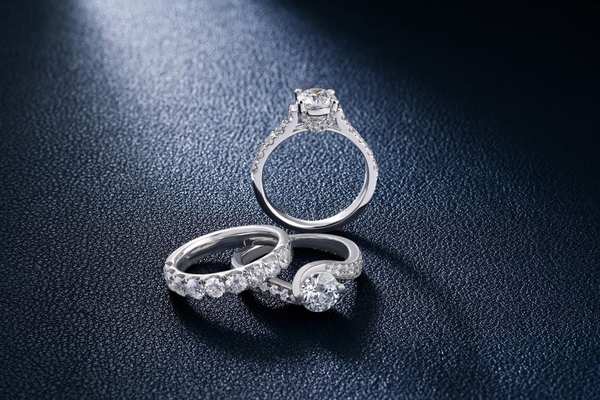
Choosing between moissanite and diamond is less about finding a “correct” engagement-ring stone and more about deciding what you want your budget to achieve. Both can look bright, elegant and suitable for daily wear, but they create light differently, carry different meanings and sit at very different price points. For UK shoppers, the same budget might buy a smaller natural diamond, a larger moissanite, or a laboratory-grown diamond somewhere between the two.
Moissanite and diamond are different gemstones
Moissanite is not a type of diamond. It is silicon carbide, while diamond is crystallised carbon. Natural moissanite is exceptionally rare, so the moissanite used in modern jewellery is laboratory-created. Diamonds are available as both natural stones and laboratory-grown diamonds. Lab-grown diamonds share diamond’s crystal structure and material properties, whereas moissanite is a distinct gemstone that can resemble diamond.
That distinction matters when comparing a moissanite engagement ring UK shoppers might see online with a diamond ring. If owning a diamond specifically matters to you, moissanite will not provide that. If your priority is appearance, durability and getting a visually larger centre stone for the money, moissanite deserves serious consideration.
Brilliance and fire: which sparkles more?
Moissanite is famous for strong sparkle. Its refractive index is higher than diamond’s, and it also has greater dispersion, so it can produce more noticeable rainbow-coloured flashes under certain lighting. Diamond tends to show a balance of white brightness and coloured fire that many people associate with the classic engagement-ring look.
This is easiest to notice in larger brilliant-cut stones under spot lighting. A large moissanite may give off vivid red, blue and green flashes, while a comparable diamond can appear slightly crisper and less rainbow-heavy. Neither effect is automatically better; it is largely a matter of taste.
A practical way to compare them
Do not judge the stones only from studio photographs. If possible, view them in daylight, ordinary indoor light and direct spot lighting. Ask to see similar shapes and sizes side by side. A larger moissanite can look more obviously different from diamond than a small one, so compare the size you actually intend to wear.
Hardness and everyday durability
Diamond ranks 10 on the Mohs hardness scale, making it exceptionally resistant to scratching. Moissanite is also very hard, commonly rated around 9.25, which is why moissanite durability is well suited to engagement rings worn every day. Both are harder than many other alternative engagement ring stones.
Hardness does not mean indestructible. A gemstone can still chip after a sharp impact, while prongs and bands can bend or wear. Have the setting checked periodically, particularly if the ring is worn during manual work, gym sessions or household tasks. For normal daily use, both stones are durable centre-stone choices.
Appearance beyond sparkle
The diamond vs moissanite decision can become clearer when you look at subtler details. Well-cut colourless or near-colourless examples of either stone can appear very white face-up, but some moissanite may show warmth in certain lighting or shapes. Moissanite is doubly refractive, which can create slight facet doubling when viewed closely from particular angles. Diamond is singly refractive, giving it a different internal appearance.
Cut quality still matters enormously. A poorly proportioned stone can look dull regardless of material. Round brilliant cuts emphasise sparkle, while step cuts such as emerald cuts reveal more of a stone’s internal character. If you are still choosing a shape, our diamond shapes guide is a useful next step; a diamond buying guide can also help if you are comparing diamond quality grades.
Price and what your budget buys
Price is where moissanite usually separates itself most clearly. For a similar visible size, moissanite is generally far less expensive than a natural diamond. That can let you choose a larger centre stone, a more elaborate setting, a higher precious-metal specification or simply spend less overall. Exact prices vary by retailer, stone size, cut, brand and ring design, so fixed percentage comparisons can be misleading.
Laboratory-grown diamonds add another option. They are diamonds rather than simulants and are generally priced below comparable natural diamonds, although market prices can change. If diamond identity matters but natural-diamond pricing feels uncomfortable, comparing lab-grown diamond with moissanite may be more useful than treating the choice as only natural diamond versus moissanite.
What to check when buying in the UK
Look beyond the centre stone. If a ring is sold as gold, platinum, silver or palladium in the UK, hallmarking rules can apply once the item exceeds the relevant exemption weight. A hallmark verifies precious-metal content; it does not certify that the centre stone is diamond or moissanite. Ask how the gemstone is described, what documentation accompanies it, and what the return, resizing and warranty terms cover.
For a diamond, an independent grading report can help explain carat weight, colour, clarity and cut. For moissanite, look for clear disclosure of the material, dimensions, colour appearance and cut. Our engagement ring settings guide is another useful internal reference because the setting affects security, maintenance and how large the stone appears.
Which stone makes more sense for you?
Choose diamond if the identity, rarity story and traditional association of diamond are central to what the ring represents, or if you prefer its particular balance of brightness and fire. Choose moissanite if you want strong durability, dramatic sparkle and more visible size for your budget without needing the centre stone to be a diamond.
A useful test is to decide which compromise would bother you more after five years: owning a smaller stone than you wanted, spending substantially more, or knowing your centre stone is not a diamond. That answer often reveals your real priority faster than comparing specifications alone.
Frequently asked questions
Can people tell moissanite from diamond?
Sometimes. The difference can be subtle in small stones, but moissanite’s stronger rainbow fire may become more noticeable in larger sizes or certain lighting. A trained gemmologist can distinguish them using appropriate testing.
Is moissanite suitable for an engagement ring worn every day?
Yes. Its high hardness makes it a practical everyday gemstone. Protecting it from hard impacts and checking the setting periodically will help keep the ring secure.
Does moissanite get cloudy over time?
Moissanite does not normally become permanently cloudy simply because it ages. Oils, soap and cosmetic residue can dull its surface temporarily, so regular gentle cleaning can restore its sparkle.
Is a lab-grown diamond the same as moissanite?
No. A lab-grown diamond is diamond with the same crystal structure as natural diamond, while moissanite is silicon carbide and a separate gemstone. They may look similar at a glance, but their optical properties and pricing differ.
Final thoughts
For value-conscious engagement-ring buyers, moissanite offers a compelling mix of sparkle, toughness and size for the money. Diamond remains the stronger fit when diamond identity, traditional appeal and its distinctive optical look matter more than maximising visible size. Compare both in the size and setting you genuinely plan to buy, then choose the stone whose trade-offs feel easiest to live with.